 Psychology - Body Language
Nonverbal communication is a two-way skill: reading the signals other people send, and controlling the ones you send. Most of the impression you make — in an interview, on a date, leading a meeting — is decided before you finish your first sentence, by your posture, face, eye contact and tone. The good news is that all of it can be trained. Here's how to get better at both sides.
Key takeaways
- You constantly send signals as well as read them.
- Align your face, posture and voice with your words.
- Small adjustments change how people respond to you.
What counts as nonverbal communication
Nonverbal communication includes everything you express without words: facial expressions, eye contact, gestures, posture, use of personal space, touch, and paralanguage (tone, pitch, pace and volume). Together these often carry more emotional weight than the words themselves — which is why a mismatch between them and your message quietly undermines you.
Part 1 — Read others better
Reading is the foundation: you can't respond well to a room you can't read. Build it the same way you'd build any skill — one channel at a time.
- Start from a baseline and watch for clusters of cues, in context.
- Learn each channel: the eyes, the face and its microexpressions, hands and arms, torso, and feet.
- Notice the gap between words and body — that's where the real message lives.
The complete framework is in how to read body language and how to read people.
Part 2 — Send stronger signals
Once you can read cues, use the same knowledge to project confidence, warmth and credibility:
- Open, upright posture. Shoulders back, chest open, weight balanced — it reads as confidence and even changes how you feel.
- Comfortable eye contact. Hold it enough to signal engagement without staring; break it naturally as you think.
- Purposeful gestures. Open palms build trust; hands visible and relaxed beat fidgeting or hidden hands.
- A genuine smile. One that reaches the eyes; it's warm, disarming and contagious.
- Mirroring & matching. Subtly matching another person's pace and energy builds rapport fast.
- Respect personal space and let your torso and feet face the person you're talking to.
- Mind your tone. A steady, lower-pitched, unhurried voice signals calm authority.
Where it pays off
- Interviews: open posture and steady eye contact read as competence and calm.
- Dating: reading and returning interest signals keeps a connection flowing.
- Leadership & sales: reading the room lets you adjust the moment engagement drops or resistance rises.
- Everyday relationships: catching how people actually feel — not just what they say — heads off misunderstandings.
Practise both sides with the app
Psychology - Body Language teaches you the full vocabulary of nonverbal communication — so you can read it in others and use it yourself:
- Download the app free on the App Store.
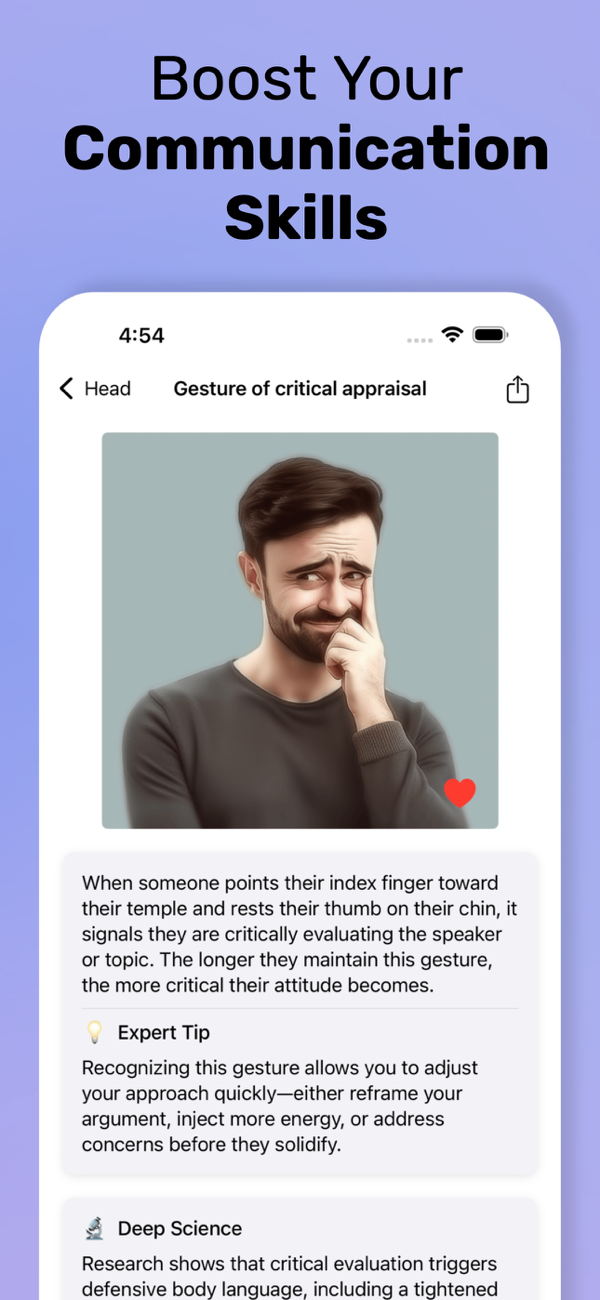
- Work through gestures by body area, each with an Expert Tip for real situations and the Deep Science behind it.
- Learn the seven universal microexpressions to read emotion accurately.
- Reinforce it with quizzes that test recognition until it's automatic — then apply it in your next conversation.
Key takeaways
- Nonverbal communication is reading and sending signals.
- Read with baseline, clusters and context; send with open posture, steady eye contact and genuine warmth.
- Make your words, face, body and tone all agree.
- Train it deliberately — study cues, then practise recognition.