 Psychology - Body Language
A microexpression is a flash of true emotion that crosses the face involuntarily — and vanishes in as little as 1/25 of a second, faster than a blink. Because they fire before the conscious mind can mask them, they're one of the most honest signals a human gives. Most untrained observers miss them completely. The good news: reading them is a learnable skill, and this guide shows you how.
Key takeaways
- Seven universal emotions flash across every face.
- A microexpression can last as little as 1/25 of a second.
- Learn each brow-eyes-mouth signature, then drill recognition.
What makes microexpressions different from normal expressions
A normal (macro) expression lasts up to a few seconds and can be posed or faked. A microexpression is involuntary and lightning-fast — it leaks the emotion a person is trying to conceal, then disappears as their "social mask" reasserts itself. Spot one and you've seen what someone actually felt, not what they wanted to show you.
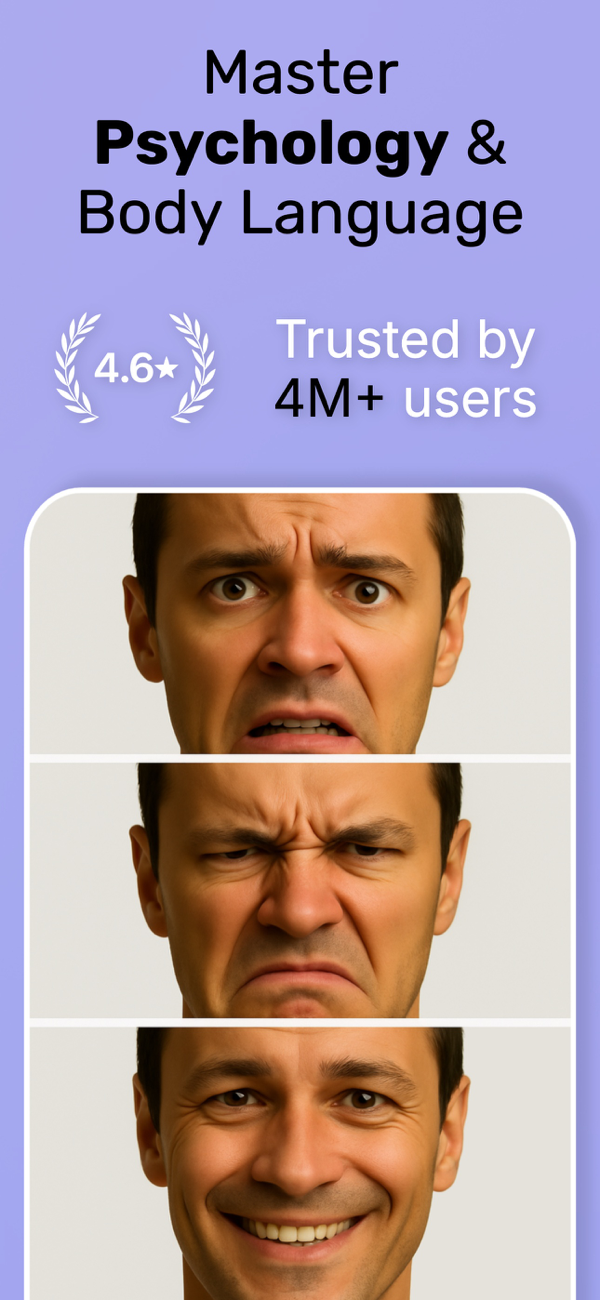
The 7 universal microexpressions and their facial signatures
The pioneering research of Dr. Paul Ekman found that seven core emotions are expressed the same way on every human face, in every culture. Learn each one's signature — the specific movements of brow, eyes and mouth:
- Happiness — cheeks raise, crow's-feet crinkle at the outer eyes, corners of the mouth lift. A genuine smile engages the eyes; a fake one doesn't.
- Sadness — inner corners of the eyebrows pull up and together, eyelids droop, mouth corners pull down.
- Anger — eyebrows lower and draw together, eyes glare, lips press or tighten into a thin line.
- Fear — eyebrows raise and pull together, upper eyelids lift showing white, lips stretch horizontally.
- Surprise — eyebrows arch high, eyes widen, jaw drops. It's the briefest emotion of all and quickly becomes something else.
- Disgust — nose wrinkles, upper lip raises, cheeks lift. The classic "smelled something bad" face.
- Contempt — the only one-sided expression: a single mouth corner tightens and lifts. A powerful and often-missed signal of disdain.
How to actually catch them: 4 steps
- Set a baseline. Watch a relaxed, neutral face first so you notice the instant it flickers.
- Watch the whole face at once. Microexpressions involve brow, eyes and mouth together — soft-focus on the full face rather than staring at one feature.
- Notice mismatches. The most revealing moment is when a microexpression contradicts the words — a flash of contempt during a compliment, fear behind a "sure, no problem."
- Drill recognition. Speed is everything. You need repeated exposure to each expression to catch it in real time — which is what practice tools and quizzes are for.
Why microexpressions matter for spotting lies
When someone lies, they often try to cover the true emotion — and it leaks as a microexpression before the cover-up completes. That's why microexpression skill and deception detection go hand in hand. As always, read them in clusters and context, not as a lone verdict.
Train recognition with the app
You can't learn to catch a 1/25-second flash by reading about it — you need reps. Psychology - Body Language turns microexpression training into a game:
- Download the app free on the App Store.
- Study each of the seven universal expressions with clear illustrations, an Expert Tip, and the Deep Science of what's happening in the face.
- Use the interactive quizzes to test recognition — you see a face or scenario and identify the emotion, with instant right/wrong feedback that sharpens your speed.
- Review the trickiest pairs (surprise/fear, anger/disgust) until you can tell them apart at a glance.
Key takeaways
- Microexpressions are involuntary, sub-second flashes of true emotion.
- Seven are universal: happiness, sadness, anger, fear, surprise, disgust, contempt.
- Learn each one's brow-eyes-mouth signature and watch the whole face.
- The gold is the mismatch between a microexpression and the words.
- Recognition speed only comes from repeated, feedback-driven practice.