 Psychology - Body Language
Everyone wants a single magic tell — the one gesture that proves a lie. The truth is more useful: liars leak, and they leak in patterns. When you know what to look for and how to read it properly, you can spot deception far more reliably than the average person, who — research consistently shows — does barely better than a coin flip. Here's how to actually do it.
Key takeaways
- No single gesture proves a lie.
- Watch for a cluster of changes timed to a sensitive question.
- Body language reveals discomfort, not guilt — probe, never accuse.
Why "he looked away, so he's lying" is wrong
The most rigorous studies agree on one thing: no single behaviour reliably indicates lying. Plenty of honest people avoid eye contact, fidget, or touch their face. Plenty of skilled liars hold perfect eye contact on purpose. If you hang a judgement on one gesture, you'll be wrong constantly — and confidently.
What does work is watching for a shift: a cluster of stress and self-soothing behaviours that appear together, at the exact moment a person is asked something sensitive, and that differ from how they normally act.
Step 1: Build a baseline first
Spend the first few minutes on easy, honest questions — things you already know the answers to. Watch how the person sits, gestures, and makes eye contact when there's nothing to hide. That relaxed pattern is your reference point. Deception shows up as a departure from it, not as any behaviour on its own.
Step 2: Watch for these body-language signs of lying
These are the cues most associated with deception in the research and in practice. On their own they mean little — but several of them clustering around a sensitive question is a genuine red flag.
Face & mouth
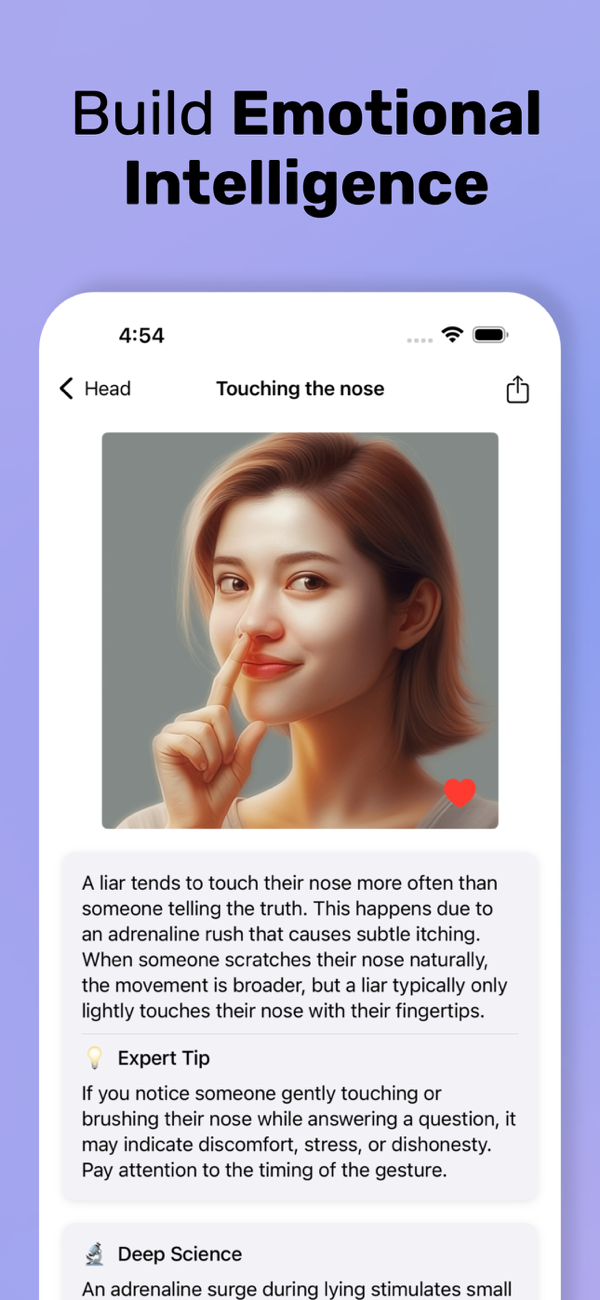
- Touching or lightly rubbing the nose. A classic tell: the stress of lying triggers a subtle itch, and liars tend to brush the nose lightly with the fingertips rather than scratch it firmly.
- Covering the mouth or partially blocking it — an unconscious attempt to "hold back" the words.
- Pursed or compressed lips when asked a pointed question.
- Throat clearing and hard swallowing from a suddenly dry mouth.
Eyes
- A break from normal eye contact — either a sudden drop or unusually rigid, forced staring.
- Rapid blinking or a burst of blinking after answering, a common stress signal.
Hands, arms & body
- Sudden stillness — a normally animated person freezing up can signal cognitive overload from constructing a story.
- Over-gesturing with both hands or, conversely, hiding the hands and turning the palms away.
- Self-soothing / grooming — touching the neck, playing with hair or jewellery, rubbing the arms.
Voice & words (bonus channels)
- Pitch rising, longer pauses, or a delay before answering while the story is assembled.
- Over-precise denials, repeating the question to buy time, or unnecessary detail to sound convincing.
Step 3: Read the cluster, in context
Now combine them. One raised eyebrow is nothing. But if, the moment you ask "were you at the office on Friday?", the person's hand drifts to their nose, their eye contact breaks, their voice climbs, and they suddenly go still — that timed cluster, breaking from their baseline, is what deception looks like. Even then it means "worth probing further," not "guilty." Ask a follow-up and watch what happens.
Train your eye with the app: learn every deception tell
You can only spot a cluster in real time if you recognise each cue instantly. That recognition is exactly what Psychology - Body Language drills:
- Download the app free on the App Store.
- Study the deception and microexpression lessons — nose-touching, mouth-covering, gaze breaks and more — each with an Expert Tip and the Deep Science behind why it happens.
- Learn the seven universal microexpressions so you can catch the emotion a liar tries to suppress.
- Take the quizzes: you're shown a real scenario and asked what it signals — instant feedback trains you to read clusters fast.
- Bring it into real conversations: baseline, question, watch for the timed cluster.
A responsible word of caution
Body language reveals stress and discomfort, not guilt. An innocent person under pressure can look exactly like a liar. Use these cues to decide where to ask more questions — never as proof, and never to accuse. Read the fuller framework in how to read body language.